The feasibility study on sand nourishment in the framework of the “Nile Delta Shoreline Stabilization (East of Kitchener Drain) Project” is this year highlighted in the Cairo Water Week (CWW) session on Coastal Protection on October 15. “During this session, experts will exchange views on the challenges, good practices and way forward to ensure sustainable protection of Egypt’s coastline”, as per the concept note. NSCE Deputy Team Leader, Eng. Tarek Kombaz presented the scope of the feasibility Study.
Coastal Protection Egypt-Netherlands Cooperation
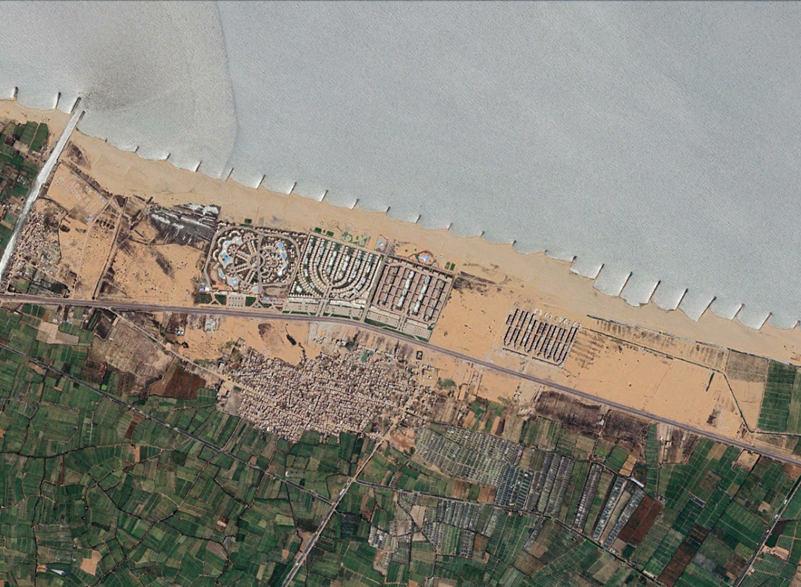
The Nile Delta in Egypt is one of the most vulnerable deltas in the world to climate change. This region accounts for more than 50% of Egypt’s economic activity through agriculture, industry, and fisheries. Therefore, any loss of prime agricultural land due to coastal erosion and flooding will have a direct adverse impact on the livelihoods of millions of people.
Egypt prioritizes the protection of livelihoods in the delta by increasing the resilience of the northern coastline against the impacts from climate change and associated sea level rise, erosion and saline intrusion by developing an Integrated Coastal Zone Management (ICZM) Plan and implementing adaptive approaches and Nature Based Solutions.
The Shore Protection Authority (SPA) as part of the Ministry of Water Resources and Irrigation (MoWRI) is responsible for protecting Egyptian’s coasts from erosion and flooding. The SPA has the mandate to carry out the necessary coastal interventions. Coastal protection in Egypt is currently predominantly implemented through hard structures such as breakwaters and seawalls. A variety of hard coastal protection measures have been experimented in Egypt, and the skills in designing and constructing hard coastal engineering works are highly developed. Nevertheless, coastal erosion is still occurring at many places along the Mediterranean shoreline.
It is anticipated that sand nourishments will be an adequate strategy to complement the existing coastal engineering works for stabilizing the coast. Coastal protection using soft, nature-based methods is relatively new in Egypt. This holds in particular for large-scale nourishments with sand extracted from the nearby continental shelf.
Past geological surveys have identified large zones on the nearby continental shelf where the characteristics of the surface sediments seem to be appropriate for sand nourishment of the coast. With support by the Netherlands, an additional survey has been carried out recently to investigate the presence of mineable sand of suitable quality in order to make well inform decisions on the long-term feasibility of coastal sand-nourishment solutions. The results from this survey will be presented during this session.
Sand extraction from the offshore seafloor can interfere with interests and uses for which several other authorities have responsibility. Parts of the inner continental shelf have been designated exclusively for maritime purposes, oil and gas exploration and extraction activities.
Transferring knowledge and know-how to the Egyptian authorities on soft coastal protection measures to become familiar with offshore sand extraction and nourishment techniques should be enhanced. Egypt has requested the Netherlands to provide support, based on the experiences with the protection of its North Sea coastline.
Session Objective:
During this session, experts will exchange views on the challenges, good practices and way forward to ensure sustainable protection of Egypt’s coastline:
- To review and compare coastal protection strategies in the Netherlands and in Egypt;
- To advise Egypt on effective and sustainable coastal protection strategies.
Project: Nile Delta Shoreline Stabilization (East of Kitchener Drain) ProjectNSCE represents the consortium with the Dutch company Witteveen+Bos during the session, while Dr. Ali Saber Ali of the Shore Protection Authority (SPA) together with NSCE Deputy Team Leader, Eng. Tarek Kombaz highlighted the Nile Delta Shoreline Stabilization (East of Kitchener Drain) Project during the slot: ‘Good Practices in Coastal Protection and experiences with Nature Based Solutions’.
The session was kicked off by the First Secretary Water Management at the Embassy of the Kingdom of the Netherlands in Cairo, Folker de Jager. He noted the presence of technical coastal engineers, especially represented by the Shore Protection Authority (SPA), rendering this one of the most technical sessions at the CWW. The Chairman of the SPA, Eng. Mohamed Ghattas then proceeded with his opening remarks.
No grain of sand allowed to leave!
Rien Van Zetten from the national Dutch agency Rijkswaterstraat (RWS) highlighted how first coastal protection meant hard structures such as dams, surge barriers, sluices, and dykes but that these have a lot of negative impacts. For example, dams hinder sediments from the river to be brought to the sea.
Soft measures such as dunes and sand nourishment, however, provide recreation, protection, freshwater, nature, and feed the cost with sediments. He then showed how to identify the shoreline and work from there:
Hold the line! A basis for action, a political choice!
He highlighted that setting up annual monitoring & evaluation of the coast is necessary to have no data gaps but also to ‘grow with the sea’ and look for ‘sandy solutions’.
The first step is then to ask:
Where is the sand? How much do we have?
How to build with nature?
Dr. Mohamed Ahmed, Executive Director of the Green Climate Fund (GCF) and UNDP Project “Enhancing Climate Change Adaptation in North Coast and Nile Delta in Egypt” (ECCADP) focused on the challenge of flooding. Flooding is caused by the rise of sea level but also due to changing weather conditions. The project aimed to respond to this challenge by asking how to build with nature, shifting from hard structures to nature-based solutions (NBS).
He considered first the best practice of changing the mindset. Engineers need to be convinced that the answer to the question ‘Do we need it?’ is yes. If the engineers are not on board, NBS it is not going to work, he said.
Subsequently, piloting and testing on small scale before upscaling is the way forward.
He then proceeded with presenting a pilot, whereby the local knowledge of the communities had been the key to success: sand transportation by wind. This led to set up of reed fences on the beach in area of 10 meters wide wherein the wind accumulatez sand. Then, the second solution with sand transportation by wind aimed to grow vegetation by means of setting up boxes, but the boxes accumulated sand faster than it allowed for vegetation to grow. Thus, it was concluded that these sand boxes can be used as a dyke. This dyke was set up for 5.5 km along the Nile Delta shoreline by wind rather than human intervention. Upon this success, the pilot was upscaled to 69 km and thus for one third of the Nile Delta Shoreline. In addition, this NBS is income-generating. The reed fences were crafted by women from the communities in Kafr El Sheikh around Burullus lake. When normally these areas are prone to yearly flooding, this time, when water was at its peak the structure stopped the water and this for 1/10 of the price of hard structures. These sandy dykes exemplify a best practice of resilient living infrastructure, that are both technically engineered but also socially engaged, highlighting local knowledges.
From local to systemic, static to modular approaches
Antoon Hendriks, Project Engineer at Boskalis, opened his presentation on stating that NBS are not necessarily feasible everywhere. One has to look at what is most feasible: hard, soft, or hybrid structures. He compared hereby the sandy versus hard solutions.
Sandy solutions: modular, gradual upscaling, space to breath, adaptive to various climate scenarios, and systemic approach
Hard solutions: static, takes up little space, one scenario, and local approach
Feasibility of Sand Nourishment in Egypt
NSCE Deputy Team Leader, Eng. Tarek Kombaz, proceeded after the introduction by Dr. Ali Saber Ali of the Shore Protection Authority (SPA), with the presentation of Consulting Services for Conducting a Feasibility Study for the envisaged Nile Delta Shoreline Stabilization (East of Kitchener Drain) Project, funded by the KfW Bankengruppe with the SPA as national counterpart. It was highlighted how this project is pioneering in Egypt and how it demands knowledge exchange to avoid duplication of efforts and to allow for synergies between different projects. In this regard, the results of the sand mapping across the Delta were considered key to move forward with the feasibility study. A prerequisite for any feasibility study of sand nourishment is sand. Subsequently, Roel Nagtegaal, Senior Geologist at Van Oord, presented the results of the sand survey having conducted the sand search project for the Nile Delta.
Future of Egypt: The Nile
Eng. Mohamed Ghattas concluded the session, highlighting how the future of Egypt is directly linked to the Nile, while Eng. Walid Hakiki, Head of Planning Sector at the Ministry of Water Resources and Irrigation, highlighted the importance of public private partnerships for financing NBS.
Key info
The session was called “Coastal Protection Egypt-Netherlands Cooperation” and held on October 15, 2025 from 09:30 AM to 13:00 PM at the Triumph Luxury Hotel, Cairo.